Healthcare Runs Around the Clock. Convenient Access Should Too

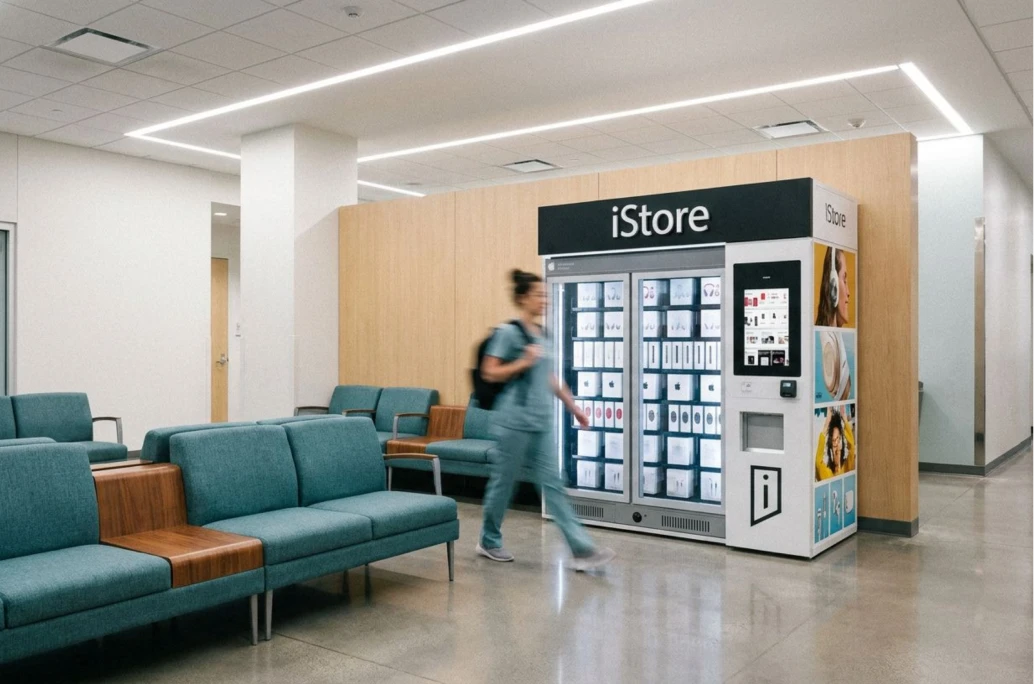
Healthcare environments rarely operate on a conventional schedule.
Patients arrive at different hours. Families wait. Caregivers move through long days. Healthcare teams work across changing shifts.
And throughout those experiences, ordinary needs still happen.
- A phone battery dies.
- Someone needs a personal care item.
- A visitor realizes something essential was left at home.
- An employee working late wants convenient access to an everyday product without leaving the facility.
The products may be ordinary.
The circumstances are not.
That is why retail access in healthcare should begin with people rather than technology.
Mercury's role is to make appropriate everyday products more accessible to patients, visitors and healthcare teams while providing operators with a managed retail format that does not require another staffed store.
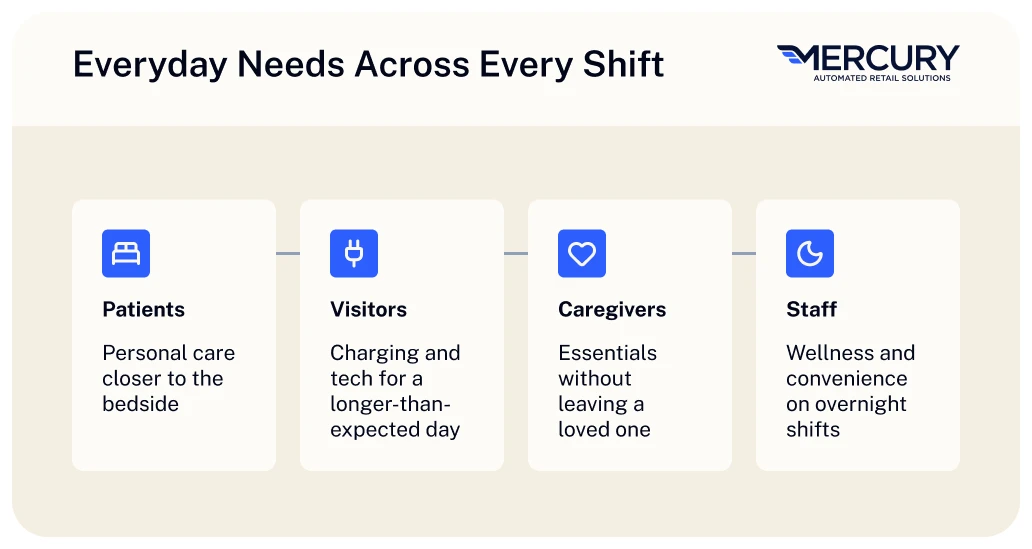
Everyday Needs Continue Across Every Shift
Healthcare facilities serve several audiences at once.
Their circumstances can be very different.
- A patient may have limited mobility.
- A visitor may have been at the facility far longer than expected.
- A caregiver may not want to leave.
- An employee may be working when conventional retail options are closed.
Each audience can encounter everyday needs during a period when convenience matters more than usual.
Mercury's healthcare strategy recognizes this environment as one shaped by long stays, changing shifts and unexpected needs, with potential relevance for technology, personal care, wellness and other appropriate essentials.
This is an important distinction.
The objective is not to turn a healthcare facility into a shopping destination.
It is to make useful products easier to access when people need them.
In Healthcare, Distance Can Become Friction
Convenience is relative.
A retailer that is a short drive away may be convenient in everyday life.
It may not be convenient to someone waiting with a family member at a hospital.
A shop elsewhere on a large healthcare campus may technically be accessible but still feel far away to an employee with a short break.
An item available through delivery may still require waiting, coordination or leaving the immediate care environment.
In these situations, proximity has value.
A well-placed automated retail experience can reduce the distance between the person and the everyday product they need.
That can be especially useful in large facilities, campuses with multiple buildings, employee areas and environments operating across many dayparts.
The principle is straightforward:
Bring appropriate essentials closer to where people already are.
The Assortment Has to Fit the Environment
Healthcare is not just another retail channel.
The environment requires judgment.
A product assortment that works in an airport, hotel or university may not automatically belong in a healthcare facility.
Relevance, trust and simplicity matter.
Potential categories can include personal care, technology, wellness and everyday essentials, with the specific assortment shaped by the environment and operator requirements.
- That might mean access to charging products for someone spending an unexpected day at the facility.
- It could mean personal care products for an overnight stay.
- It could mean relevant wellness or everyday convenience products for staff.
Where over-the-counter categories are considered, applicable rules, approvals and operating requirements need to be part of the decision.
The important principle is that the assortment follows the environment.
Not every product belongs everywhere.
Access Should Not Create Another Operational Burden
An unattended transaction does not mean unattended operations.
Retail still requires management.
- Inventory has to be available.
- Products have to be replenished.
- The store needs to function reliably.
- Issues need to be addressed.
- The environment should remain appropriate and organized.
- Performance needs to be understood.
For healthcare operators, this distinction is critical.
The value proposition should not be:
Here is another machine for your team to manage.
It should be:
Here is another way to provide convenient access, supported by an operating model designed to manage what happens after deployment.
Mercury's model connects technology with fulfillment, service, measurement and optimization rather than treating installation as the end of the process.
That operational accountability is particularly important in healthcare, where the retail experience cannot become a distraction from the organization's primary mission.
Location Matters as Much as Assortment
A hospital or healthcare campus can contain many distinct environments.
The right retail opportunity depends on the people using each one.
- A waiting area can create a different occasion from an employee zone.
- A main lobby can behave differently from a building operating late into the evening.
- A high-traffic public area may call for a broader assortment than a more specialized location.
That is why automated retail planning should not begin by asking:
Where is there an empty wall?
It should begin with:
Where are people spending time, and where does convenient access break down?
The difference is significant.
Available space is not necessarily productive space.
Productive space exists where traffic, relevance, visibility, access and operating feasibility align.
Technology Should Make the Experience Simpler
Healthcare is already complex enough.
Retail should not add to that complexity.
The strongest experience is easy to understand.
- The purpose of the store is clear.
- The assortment is relevant.
- The interface is intuitive.
- The transaction is fast.
- The consumer can return attention to the reason they are actually at the facility.
That is why Mercury's healthcare proposition should not lead with robotics, automation or technical sophistication.
Those capabilities matter behind the experience.
The customer-facing benefit is simpler:
Everyday essentials, within reach.
Technology is valuable when it makes that promise easier to deliver.
Better Access Can Be a Small but Meaningful Improvement
Automated retail will not transform healthcare delivery.
Nor should it pretend to.
Its role is narrower and more practical.
- It can help an employee get what they need during an overnight shift.
- It can help a visitor avoid leaving the facility.
- It can help a patient or caregiver access an everyday essential closer to where they are.
- It can help an operator extend convenience without adding another staffed retail environment.
Those may seem like small improvements.
But healthcare experiences are made up of many small interactions.
When people are tired, worried, working long hours or managing an unexpected stay, reducing even one unnecessary inconvenience can matter.
That is the opportunity.
Not retail for retail's sake.
Access designed around the people already there.
FAQs
1. Who can healthcare automated retail serve?
Depending on placement and assortment, it can serve patients, visitors, caregivers, employees and other people spending time within the healthcare environment.
2. What products belong in healthcare retail?
The assortment should be appropriate to the facility and occasion. Potential categories include technology, personal care, wellness and everyday essentials, subject to applicable requirements.
3. Is this a clinical service?
No. Mercury's role is retail access to appropriate consumer products, not healthcare delivery or clinical guidance.
4. Why use automated retail rather than another staffed shop?
Automated retail can extend access across additional locations and hours without requiring a cashier at every point of sale, while a managed operating model supports inventory and service.
What This Unlocks
The same access principle applies in other environments where people spend significant time beyond conventional retail hours. Explore Mercury's perspectives on Airports, Hospitality and Higher Education.
Follow the Economics of Modern Physical Commerce.
Get practical insight on location fit, managed operations, and channel growth.