Campus Life Doesn't Keep Store Hours. Why Should Retail?

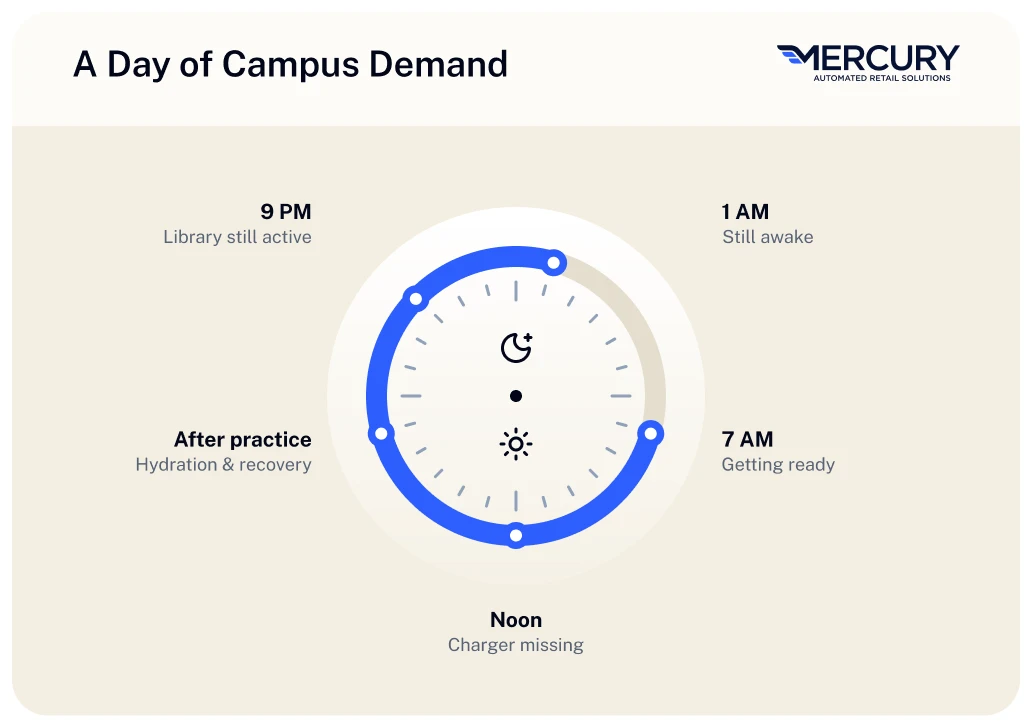
- At 7 a.m., a student is getting ready for class.
- At noon, someone realizes their charger is missing.
- After practice, the priority might be hydration or recovery.
- At 9 p.m., the library is still active.
- At 1 a.m., students may still be awake even though most campus retail is not.
Campus life moves continuously between residence halls, academic buildings, recreation, libraries, student centers and social spaces.
Retail access often does not.
That creates a simple opportunity:
What if retail access followed campus life?
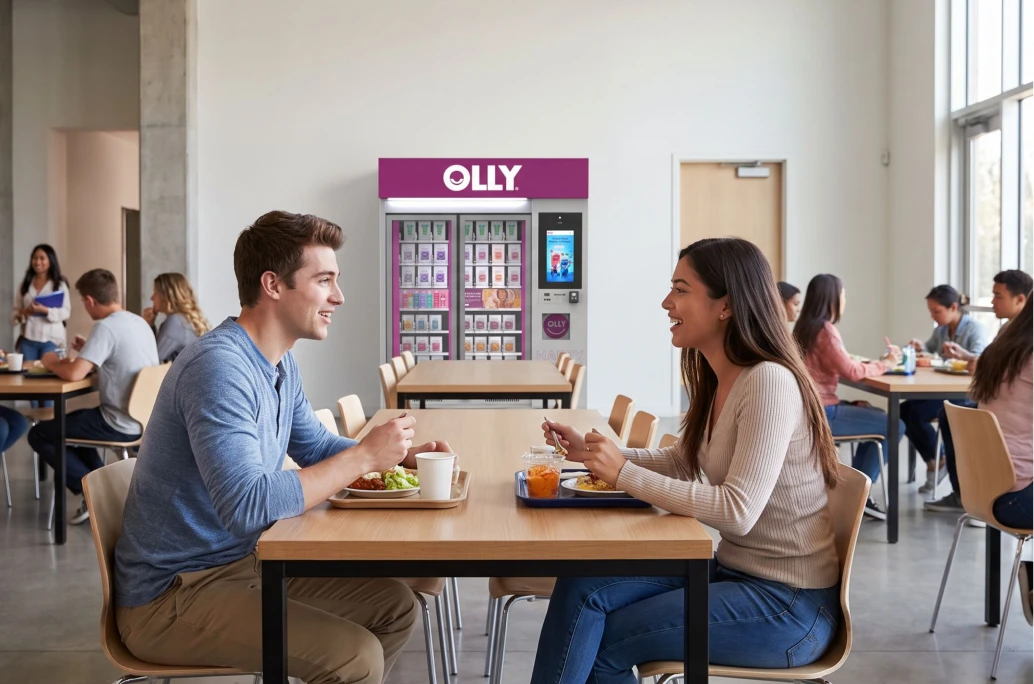
Mercury enables universities to place relevant products closer to where student, faculty and staff demand occurs, extending convenience without requiring a staffed store everywhere that demand exists.
Campus Demand Changes Throughout the Day
Higher education is not a single retail occasion.
A campus can function almost like a small city.
- People live there.
- They study there.
- They work there.
- They exercise there.
- They attend events.
- They socialize.
And each activity creates different consumer priorities.
A student leaving a residence hall in the morning may want something completely different from someone studying in a library late at night.
A faculty member moving between meetings has a different occasion from an athlete leaving recreation.
Mercury's approach focuses on occasions such as energy, focus, wellness and everyday convenience rather than treating the entire campus as one uniform retail environment.
This makes daypart an important planning variable.
But daypart alone is not enough.
Location Changes the Occasion
Consider a residence hall.
The surrounding retail opportunity might include personal care, technology, wellness and everyday essentials.
Move the same retail concept into an academic building and the priorities can change.
- Charging and technology may become more relevant.
- Convenience between classes may matter more.
- In recreation, hydration, wellness and recovery can become stronger occasions.
- Near a library or study environment, technology, energy and late-night convenience may become more important.
The lesson is simple:
A campus is one community made up of many different consumer contexts.
That is why the goal should not be to install the same assortment everywhere.
It should be to understand the location first and design the retail around it.
After-Hours Access Is Only Part of the Opportunity
It is easy to reduce automated campus retail to a 24/7 proposition.
Around-the-clock availability is useful.
But it is only part of the value.
A store can be open 24 hours and still be irrelevant.
The larger opportunity is distributed convenience.
- A student should not necessarily have to cross campus every time a small need arises.
- Faculty and staff should not have to rely on a single central retail destination.
- High-traffic areas can create different retail occasions throughout the day.
Automated retail makes it possible to extend access into more of those environments without operating a staffed shop at each one.
So the more useful question is not:
How late is the store open?
It is:
How close is the right product when someone wants it?
Availability and proximity work together.
The Assortment Should Follow Campus Life
The technology may be consistent across a network.
The merchandise should not have to be.
- Residence life may call for everyday essentials.
- Academic settings may create technology and convenience occasions.
- Recreation can support hydration, wellness and recovery.
- Late-night environments can create different priorities again.
Price also matters.
A campus audience is not unlimited in spending power, and product selection should reflect the consumer and the occasion rather than simply maximizing assortment.
Mercury's broader approach considers consumer need, occasion, location, brand, merchandise, package, price and experience before execution.
That principle is particularly relevant in higher education.
Students quickly recognize when something feels designed for them and when it does not.
The retail experience should therefore feel useful, accessible and appropriate to campus life.
Campus Retail Can Become More Distributed
Traditional campus retail will continue to play an important role.
Bookstores, dining, convenience markets and other established services provide experiences and assortments automated retail is not designed to replace.
The opportunity is to extend the network around them.
A distributed model can create additional points of access near residence, study, recreation and other high-demand locations.
That can improve convenience while potentially making compact or underutilized spaces more productive.
It can also give campus operators new information.
- Which categories perform in which environments?
- When does demand appear?
- Which products resonate?
- Where is retail access most valuable?
Over time, transaction and operating signals can inform better assortment and placement decisions.
The result is not simply more stores.
It is a more responsive campus retail network.
The Brand Opportunity Is Different on Campus
Higher education also creates a distinctive opportunity for consumer brands.
Campus environments bring together concentrated communities with recognizable routines and recurring occasions.
But successful brand participation should be based on relevance, not simply exposure.
- A wellness brand may fit a recreation or residence occasion.
- A technology product may be more relevant near academic or study environments.
- A personal care product may belong closer to residence life.
The question should always be:
Why would this brand matter here?
When that answer is clear, automated retail can give brands a managed route into campus life while giving students convenient access to products relevant to the occasion.
For brands, the value can include discovery, trial, transactions and performance insight.
For campuses, the same model can expand assortment and convenience.
Again, the strongest outcome occurs when both sides are serving a genuine consumer occasion.
Put Convenience Where Campus Life Happens
The future of campus retail does not need to be defined by choosing between traditional stores and automation.
Universities can use different formats for different jobs.
- A bookstore can remain a destination.
- Dining can remain central to campus life.
- Convenience stores can serve broad everyday demand.
- Automated retail can extend access into the spaces and hours between them.
The strategic principle is straightforward:
Follow campus life.
- Understand where people are.
- Understand what they are doing.
- Understand what might be useful.
- Then determine whether retail access belongs there.
When location, occasion, assortment and experience align, automated retail becomes more than an amenity.
It becomes part of the infrastructure of campus convenience.
FAQs
1. Does automated retail replace campus bookstores or convenience stores?
It does not need to. Its strongest role can be extending access into additional locations and hours that complement established campus retail.
2. Where can automated retail work on campus?
Potential environments include residence halls, academic areas, recreation facilities, libraries, student centers and other high-traffic locations where relevant demand exists.
3. What products make sense for students?
The assortment should depend on location and occasion. Technology, wellness, hydration, personal care and everyday convenience categories can all be relevant in different campus contexts.
4. Why is placement important?
Demand varies across campus. A useful assortment in a residence hall may differ substantially from what students want near recreation or academic environments.
What This Unlocks
The same approach, designing retail around the consumer occasion rather than simply available space, extends across Mercury's work in Airports, Hospitality and Healthcare.
Follow the Economics of Modern Physical Commerce.
Get practical insight on location fit, managed operations, and channel growth.