The Guest Journey Doesn't End When the Hotel Shop Closes

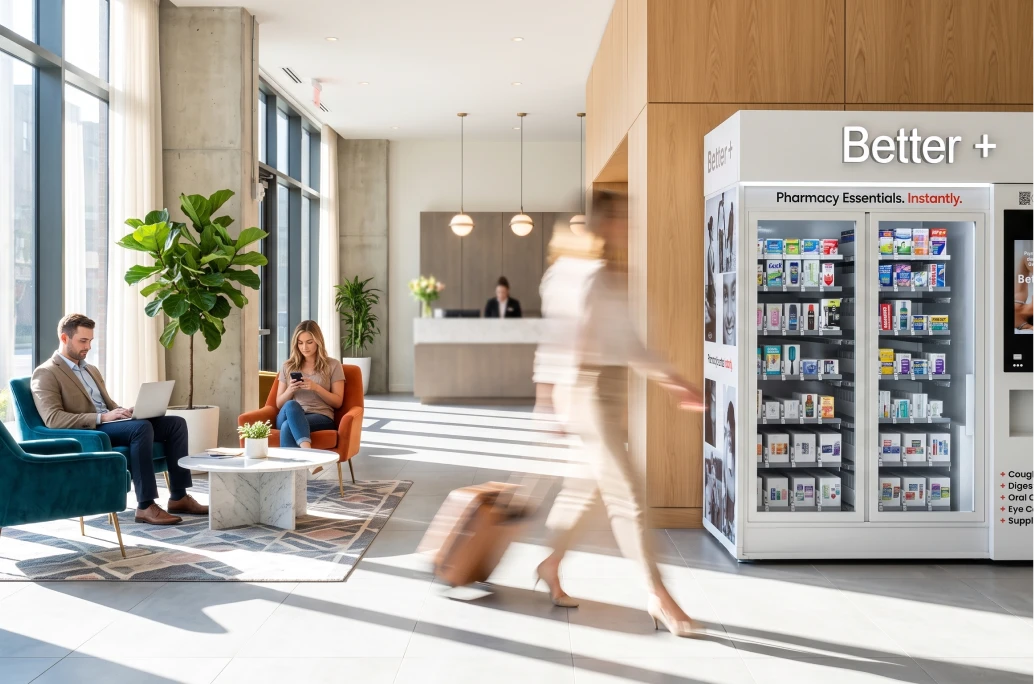
A hotel guest's day rarely follows the hotel's retail schedule.
Someone checks in late and realizes they forgot toothpaste. A business traveler needs a charger before an early meeting. A guest returns from the fitness center looking for hydration. Someone else gets back to the property late at night and wants a personal care or wellness item without leaving again.
These are ordinary situations.
But in hospitality, ordinary situations can shape the overall experience.
Hotels have traditionally addressed these occasions through lobby markets, staffed shops, the front desk or nearby retailers. Each can work well. Each can also have limitations around hours, staffing, assortment and proximity.
Managed automated retail adds another option: put useful products closer to guests throughout the stay without requiring another staffed retail operation.
That changes the planning question from:
Where should the hotel put a store?
to:
Where do guests encounter opportunities for greater convenience throughout their stay?
The Stay Creates Multiple Retail Occasions
A hotel stay is not one continuous consumer occasion.
It changes.
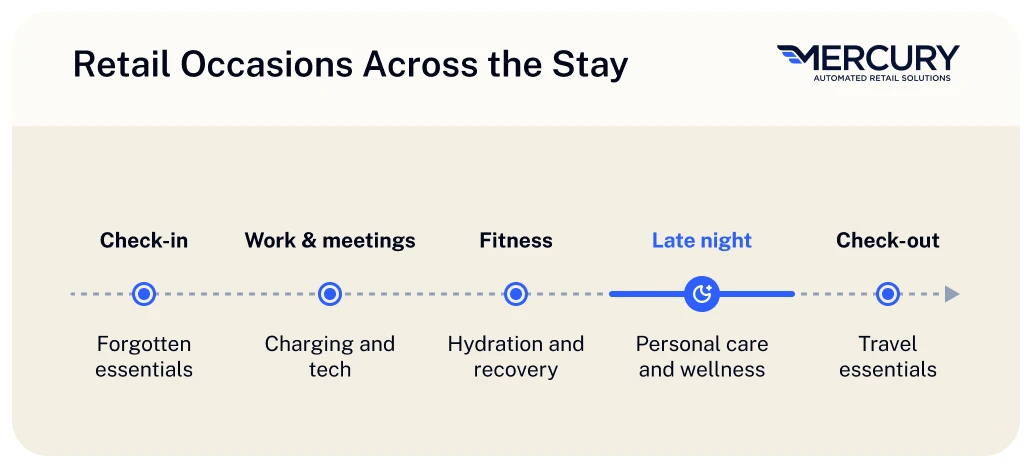
- At check-in, a guest may discover something was forgotten.
- During meetings or work, the priority may become charging, technology or quick convenience.
- Around fitness and wellness, hydration, recovery or self-care may become more relevant.
- At night, availability becomes increasingly important as nearby options close.
- At check-out, travel essentials and last-minute purchases can reappear.
Mercury's strategy therefore treats hospitality retail as a sequence of guest occasions rather than one generic convenience offer.
The distinction matters because an assortment designed around the entire stay can be more useful than simply placing the same products everywhere.
Convenience Is Part of the Guest Experience
Hospitality is built around reducing friction.
- A smooth check-in matters.
- Clear wayfinding matters.
- A comfortable room matters.
- The ability to solve a small problem without leaving the property can matter too.
Imagine a guest realizing at 10:30 p.m. that a charging cable never made it into the suitcase.
The item itself is inexpensive relative to the hotel stay. But the inconvenience of finding it can be disproportionate.
Does the guest call the front desk?
Walk to a nearby store?
Use a delivery service?
Go without it?
The best hospitality experiences often feel effortless because the property has anticipated situations before they become problems.
Retail access can operate the same way.
A well-placed automated retail experience gives the guest another path: find the relevant product nearby, purchase it quickly and return to the stay.
The technology should almost disappear behind the convenience.
After-Hours Access Is More Than a 24/7 Claim
Around-the-clock access is useful, but 24/7 alone is not a strategy.
A store can remain open all night and still provide little value if it contains the wrong products, sits in the wrong location or creates a confusing experience.
The stronger question is:
What becomes more valuable to the guest when other options are less convenient?
That is where assortment and location become important.
Late-night demand may emphasize personal care, wellness, hydration, technology and other practical essentials. The exact mix should depend on the property and its guests.
- A convention hotel may create different demand from a resort.
- An airport hotel may differ from a luxury urban property.
- A select-service hotel may have different operational requirements from a large full-service property.
The opportunity is therefore not simply retail that never closes.
It is relevant retail when convenience matters most.
Retail Can Extend Without Adding Another Staffed Shift
The guest-experience case is only one side of the equation.
Hotels also have to operate efficiently.
A staffed retail format introduces labor, scheduling and management requirements. Extending its hours can increase those requirements further.
Managed automated retail can provide additional coverage without requiring a cashier to be present for every transaction.
But removing the cashier does not remove the work.
- Inventory still has to be managed.
- Products need to be replenished.
- The equipment must function.
- The assortment needs to remain relevant.
- Performance should be monitored.
That is why Mercury's positioning is built around a managed operating model, not simply automated equipment.
The operator should not be asked to become an unattended-retail expert simply because the technology is automated.
Every Property Has a Different Opportunity
There is no universal hospitality assortment.
There should not be.
The strongest retail experience should reflect the property.
- A conference hotel may see stronger technology, charging and business-travel occasions.
- A resort may create more wellness, recreation, personal care and family-oriented demand.
- An airport hotel may have more late arrivals, early departures and forgotten travel essentials.
- A select-service property may value broader convenience coverage where staffed amenities are intentionally limited.
The building itself matters too.
Where do guests naturally travel?
Where do they wait?
Where are they likely to discover a need?
Where does existing retail access decline?
Where can a compact footprint add convenience without disrupting the environment?
The answer may be the lobby, a meeting area, a fitness zone or another high-traffic location.
The goal is not maximum placement.
It is useful placement.
Start With the Guest. Then Design the Retail.
Retail technology can make a property more capable.
But technology should not be the starting point.
The guest should.
What is happening in the stay?
What might the guest need?
How urgent is it?
What alternatives exist?
Where would access feel natural?
Which products belong in that context?
Only after answering those questions should the retail experience be designed.
That approach also creates a better brand opportunity.
For a consumer brand, hospitality can provide something traditional advertising cannot: a chance to become useful in a real-world situation.
- Hydration after exercise.
- A charger before a meeting.
- Personal care after a late arrival.
- Wellness during travel.
The brand is not simply gaining an impression. It is participating in a relevant purchase occasion.
For the property, the same transaction can improve convenience while retaining more guest spending on-site.
For the guest, it simply solves the problem.
That is when the model works best: guest value, property value and brand opportunity converge around the same occasion.
From Hotel Retail to a Better Guest Experience
The future of hotel retail does not need to look like a larger gift shop.
It can look like greater access.
- A useful product in the right place.
- An option available after staffed retail closes.
- A purchase that takes moments rather than requiring the guest to leave the property.
- A compact footprint that creates commercial value without adding another staffed operation.
None of these individually transforms hospitality.
Together, however, they can remove friction from the stay.
And in an industry built around experience, removing friction matters.
FAQs
1. Is automated retail intended to replace a hotel market or gift shop?
Not necessarily. It can complement existing retail by extending access into additional locations or operating hours.
2. What should hotels sell through automated retail?
The assortment should reflect the property and guest journey. Relevant categories can include personal care, wellness, hydration, technology, travel essentials and other convenience products.
3. Where should automated retail be located in a hotel?
The right placement depends on traffic, guest behavior, existing amenities and access gaps. High-visibility areas connected to real guest occasions are generally more useful than placement based on available space alone.
4. Does the hotel have to operate the store?
Mercury's model is designed around managed retail operations rather than simply supplying equipment.
What This Unlocks
Guest demand is only one example of a larger shift toward retail designed around real-world consumer occasions. Explore Mercury Insights across Airports, Healthcare and Higher Education.
Follow the Economics of Modern Physical Commerce.
Get practical insight on location fit, managed operations, and channel growth.