The Airport Retail Opportunity Beyond the Concession Footprint

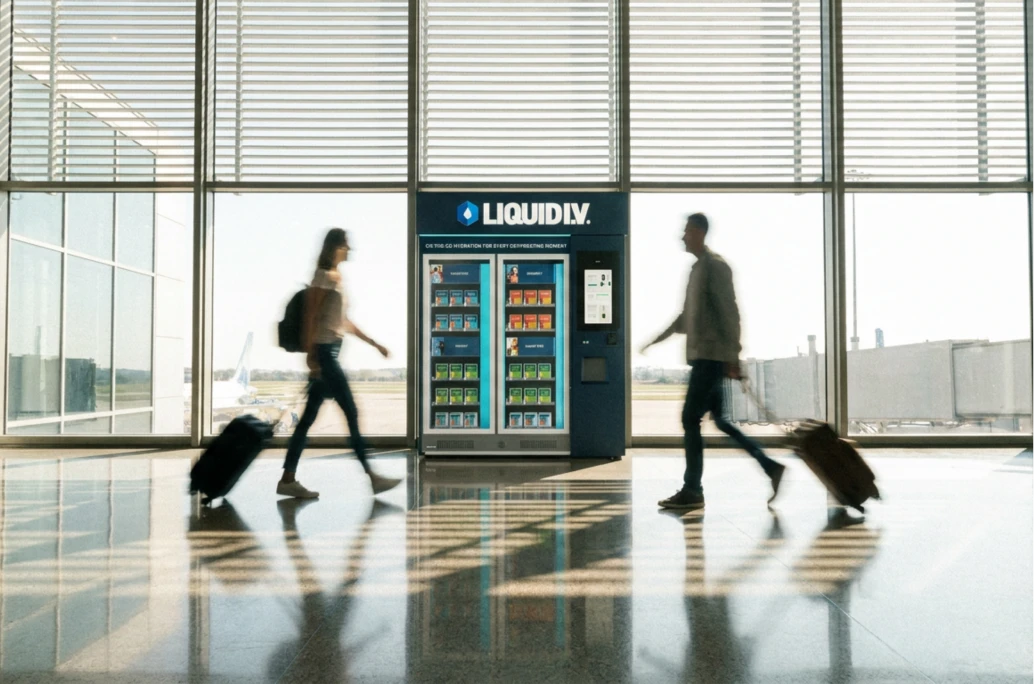
Airports are built around movement.
Passengers arrive, check bags, clear security, navigate terminals, wait at gates, change concourses and board. Along the way, their priorities can change quickly. A traveler who entered the terminal with everything they needed may discover an hour later that their phone is dying, they want hydration before boarding, or they forgot a personal care item.
Traditional airport concessions play an essential role in serving those travelers. But a physical store cannot be everywhere a passenger need occurs.
That creates an opportunity for airport retail to become more distributed.
Mercury approaches that opportunity with a straightforward question: Where does passenger demand exist that traditional retail cannot conveniently reach?
The answer may be near a gate, along a high-traffic corridor, during an off-hour, or in a location where another staffed retail concept does not make operational or economic sense.
The objective is not to replace airport concessions. It is to complement them by bringing relevant products closer to passengers at additional points in their journey.
Airport Retail Is a Journey, Not Just a Destination
Airport retail has traditionally been organized around destinations: convenience stores, specialty retailers, newsstands, food and beverage concessions, duty-free environments and other established concepts.
Those formats remain important. But passengers do not experience an airport as a collection of retail units. They experience it as a journey.
That distinction matters.
Someone may walk past a retail store immediately after security because they do not need anything yet. Thirty minutes later, sitting at the gate, the situation can be completely different.
The phone battery is low. The flight is delayed. The passenger wants hydration, personal care, wellness support or something useful for the flight.
The demand has appeared after the traditional retail interaction has already passed.
Mercury's strategic model starts with the consumer occasion before determining the product or format. The question is not simply which automated store can fit into a space. It is whether the consumer, occasion, location, brand, merchandise, price and experience fit together.
That shifts airport retail planning from:
Where can another store fit?
to:
Where are passengers encountering demand that is not being fully served?
The second question creates a much broader view of the commercial opportunity.
Time Pressure Changes How Passengers Shop
Airports create an unusual retail environment because consumers are balancing both dwell and urgency.
A passenger might have an hour before boarding but still be reluctant to walk ten minutes away from the gate. Another may have only a few minutes between connections. Someone else may be comfortable browsing but wants the purchase itself to be fast and predictable.
That means convenience is not simply about opening hours.
It is also about proximity, relevance and speed.
In a time-sensitive environment, a smaller, more relevant assortment can sometimes be more useful than a much larger assortment located farther away.
The traveler does not necessarily want to browse hundreds of products. They may simply want to solve the immediate problem and continue the journey.
That is why Mercury's airport strategy emphasizes travel relevance, visibility, speed and placement near passenger flow rather than treating automated retail as a machine-placement exercise.
The strongest experience should make the decision easy:
"I recognize what this store is for."
"I can see something relevant to me."
"I can purchase it quickly."
"I can continue my journey."
That is retail designed around the passenger rather than asking the passenger to adapt to the retail.
The Opportunity Exists Between Traditional Retail Locations
An airport does not need another full concession everywhere passengers gather.
In many locations, that would be impractical.
But that does not mean those locations have no commercial potential.
Gates, corridors, waiting areas and other passenger zones can contain meaningful demand even when the footprint, staffing requirement or economics do not support a traditional retail format.
Managed automated retail creates another option.
A compact retail footprint can extend product access into locations that may otherwise remain underserved. It can also operate beyond conventional staffed hours.
Mercury's own operating data provides a useful signal here. In one Better+ measurement period from January through March 2026, 39.4% of transactions occurred between 7 p.m. and 7 a.m.
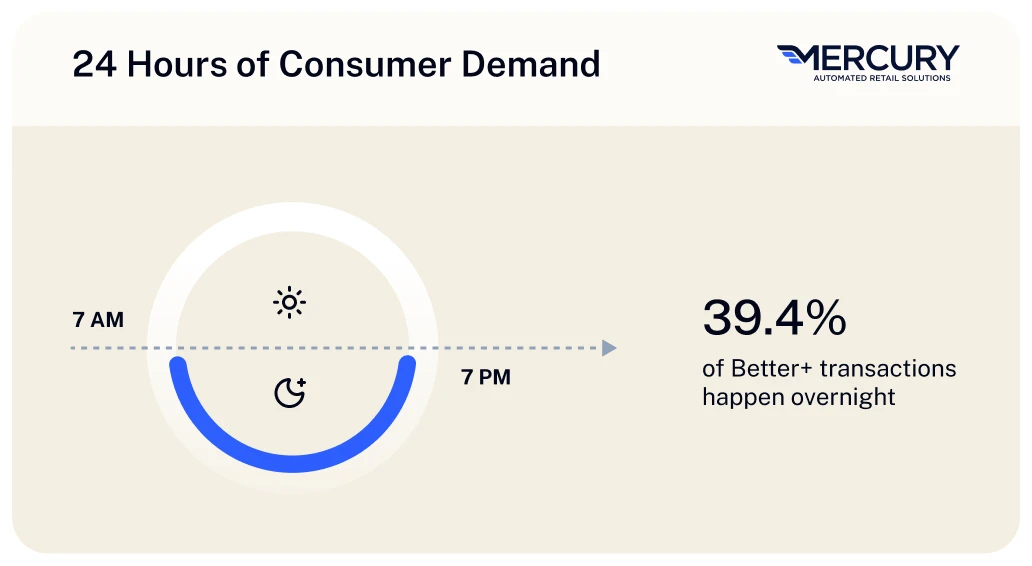
That figure should not be interpreted as a universal prediction for every airport or retail concept. It does demonstrate something strategically important: meaningful purchase behavior can occur outside the hours traditionally associated with staffed retail.
For an airport operator, that creates a new planning question.
Instead of asking only how to maximize established concession zones, airports can also examine where demand continues before, between and after those zones.
Right Product. Right Location. Right Time.
Automated retail does not create value simply because it operates without a cashier.
The proposition still has to be right.
A hydration concept that works in one part of an airport may not be the best answer somewhere else. A technology assortment near a gate may serve a different occasion than personal care or wellness products in another location.
Mercury's approach is built around fit:
- Consumer need: What problem or desire exists?
- Occasion: Why would someone act now?
- Location: Where does that demand occur?
- Brand and merchandise: Which products are relevant enough to earn attention?
- Price and package: Does the offer make sense in the situation?
- Experience: Can the consumer understand and complete the purchase quickly?
The technology enables the transaction. Fit creates the reason for the transaction.
This distinction is particularly important in airports because passenger demand is not uniform.
International versus domestic travel, business versus leisure, departures versus arrivals, gate dwell versus connecting traffic and early morning versus late evening can all create different purchase occasions.
The objective should therefore be a network of retail experiences responsive to passenger context, not simply a network of identical machines.
What Should Airport Operators Evaluate?
A strong automated retail opportunity starts before installation.
Airport teams should evaluate several factors together.
- Passenger flow: Is there meaningful traffic near the proposed location?
- Dwell: Do passengers spend enough time in the area to notice and use the experience?
- Retail coverage: What needs are already well served nearby, and where are the gaps?
- Daypart: Does demand continue when surrounding concessions have limited availability?
- Assortment: Which products make sense for the passenger and location?
- Visibility: Can the retail experience communicate its purpose quickly?
- Operations: Can inventory, service and uptime be managed consistently?
- Economics: Can the footprint create meaningful commercial value?
No single variable guarantees success.
A busy location with the wrong assortment can underperform. A relevant assortment hidden from passenger flow may never get the attention it deserves.
The opportunity comes from bringing those variables together.
Automated Retail Should Complement the Airport Ecosystem
It is tempting to frame new retail formats as replacements for existing ones.
That misses the larger opportunity.
Traditional concessions provide assortment, service, discovery, hospitality and brand experiences that automated retail is not designed to replicate in every situation.
Automated retail solves a different problem.
- It can extend access.
- It can make compact spaces productive.
- It can serve a passenger close to the point of need.
- It can operate during periods when staffing another retail location may be difficult.
- And it can introduce brands or product categories into locations where a conventional store may not be practical.
The better question is therefore not traditional retail or automated retail?
It is:
What combination of retail formats creates the best passenger experience and commercial outcome across the airport?
That is a much more useful framework for the future of airport commerce.
The Airport Can Become a Distributed Retail Network
The larger opportunity is to stop viewing each retail unit in isolation.
An airport can function as a connected network of different retail experiences, each designed around a particular passenger context.
- Traditional concessions remain major destinations.
- Automated retail can extend the network.
- Brands can participate through assortments and dedicated concepts.
- Performance data can reveal which products, locations and dayparts generate response.
Over time, those signals can help operators make better decisions about what belongs where.
The airport of the future does not necessarily need retail everywhere.
It needs the right retail in the right places.
That is the opportunity beyond the concession footprint.
FAQs
1. Does automated retail replace airport concessions?
It does not need to. Its strongest role can be complementary, extending access into locations, dayparts and purchase occasions that traditional concessions may not fully serve.
2. What products work in airport automated retail?
The assortment should follow the passenger occasion and location. Depending on context, that may include hydration, wellness, personal care, technology, travel essentials and other relevant categories.
3. Why does location matter so much?
Airport demand changes throughout the passenger journey. A concept that makes sense near one gate or passenger flow may not make sense elsewhere.
4. Can automated retail operate outside normal concession hours?
Yes. One advantage of the format is the ability to provide access beyond staffed retail hours, assuming the location itself remains accessible.
What This Unlocks
The same principle applies anywhere consumer demand extends beyond conventional retail access. Explore how Mercury approaches Hospitality, Healthcare and Higher Education through the Insights hub.
Follow the Economics of Modern Physical Commerce.
Get practical insight on location fit, managed operations, and channel growth.